

What are Adjectives?
Adjectives are words that give more information about nouns. A noun is a person, place, animal, or thing.
- They tell us what something is like.
- They make your sentences more descriptive and interesting.
For example, in the phrase an amazing film, the word amazing is an adjective that describes the noun film.
✍️ Du bist dir nicht sicher, auf welchem Niveau du bist?
Machen Sie unseren kostenlosen Einstufungstest und erhalten Sie individuelles Feedback von zertifizierten Cambridge-Prüfern.
Machen Sie unseren KOSTENLOSEN EinstufungstestAdjectives for Positive Descriptions
We use these adjectives to say that something is very good or enjoyable:
- Amazing: This means something is extremely good or surprising. The concert was amazing!
- Awesome: Similar to amazing, it means very impressive or excellent. My new phone is awesome.
- Interesting: This means something holds your attention or makes you want to know more. I read an interesting book about history.
Adjectives for Negative Descriptions
We use these adjectives to say that something is bad or not enjoyable:
- Boring: This means something is not interesting and makes you feel tired or sleepy. The meeting was so boring.
- Horrible: This means something is very bad, unpleasant, or causes fear. The weather was horrible yesterday.
- Terrible: Similar to horrible, it means extremely bad or severe. The food at that restaurant was terrible.
How to Use Adjectives in Sentences
Adjectives usually go in two main places in a sentence:
- Vor einem Substantiv: The adjective comes directly before the noun it describes. It was an amazing film. She has an interesting job.
- After the verb ‘to be’ (am, is, are, was, were): The adjective describes the subject of the sentence. The book is boring. They were terrible.
| Positive Adjectives | Negative Adjectives |
|---|---|
| amazing | boring |
| awesome | horrible |
| interesting | terrible |
Beispiele
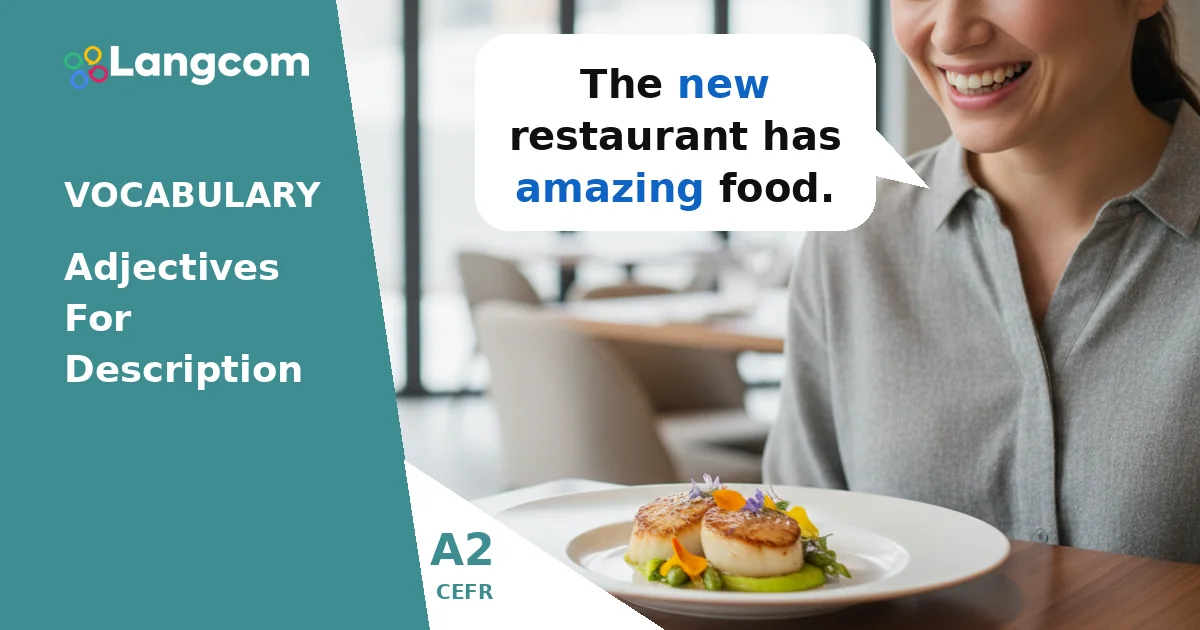
- The new restaurant has amazing food.
- My holiday in Spain was awesome!
- I found an interesting article online.
- That TV show is really boring.
- The traffic was horrible this morning.
- I had a terrible headache yesterday.
Übung
Bist du bereit, dein Zertifikat zu erwerben?
Der Kurs Langcom bereitet die Teilnehmer auf die Prüfungen von Cambridge, IELTS, TOEFL, DELE, SIELE und Michigan vor.
Erste Schritte mit LangcomHäufige Fehler bei Spanischsprechern
Confusing Adjectives Ending in -ing and -ed
Spanish speakers sometimes confuse adjectives ending in -ing und -ed. This is a common mistake at A2 level.
- -ing adjectives describe the thing or situation that *causes* a feeling. For example, The film was boring means the film made people feel bored.
- -ed adjectives describe how a person *feels*. For example, I was bored means I felt boredom.
Remember: The book is interesting. I am interested. Not I am interesting (unless you mean you are a person who causes interest in others!).
Häufig gestellte Fragen
What is the main job of an adjective?
The main job of an adjective is to describe a noun or pronoun. It gives more information about what something or someone is like, such as a terrible film oder an amazing person.
Can adjectives describe feelings?
Yes, many adjectives describe feelings, like happy, sad, oder bored. However, remember that adjectives ending in -ing (wie boring) describe the *cause* of the feeling, while -ed adjectives (like bored) describe the *feeling itself*.
How can learning these adjectives help me with the A2 Key exam?
Learning descriptive adjectives is very helpful for the A2 Key exam, especially in the Speaking and Writing parts. You can use them to describe pictures, talk about your opinions on films or books, or write short messages. For example, in A2 Key Part 2 (Speaking), you might need to describe a photo, and adjectives like amazing oder horrible will help you express your ideas clearly.
Do adjectives change form in English?
No, adjectives in English do not change their form for singular or plural nouns, or for masculine or feminine nouns. For example, you say an amazing film und amazing films. The adjective amazing stays the same.


0 Kommentare