
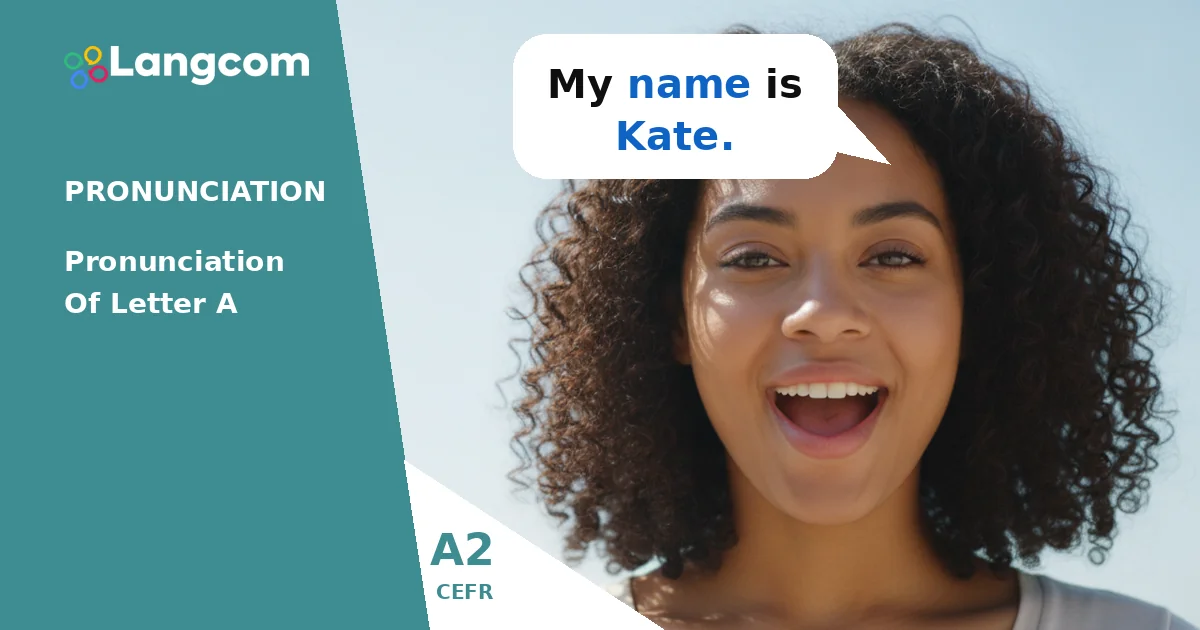

Why is ‘A’ Pronunciation Important in English?
A carta A is very common in English words. However, it does not always sound the same. This can be confusing for English learners.
Learning the different sounds of A helps you:
- Speak more clearly.
- Understand native speakers better.
- Feel more confident when you talk.
- Perform well in pronunciation tasks, like those in the A2 Key exam.
✍️ Not sure which level you are?
Take our free placement test and get personalized feedback from certified Cambridge examiners.
Faça nosso teste de nivelamento GRATUITOSound 1: The Long 'A' /eɪ/ (as in 'face')
This sound is like saying the name of the letter A itself. Your mouth moves from a slightly open position to a narrower one.
- You often hear this sound when A is followed by a consonant and then an E (e.g., make, name).
- It also appears with AI (e.g., rain, wait) e AY (e.g., play, day).
Sound 2: The Short 'A' /æ/ (as in 'cat')
This sound is a short, open sound. Your mouth is wide, and your tongue is flat in the middle of your mouth.
- It is common in short words with a consonant-vowel-consonant (CVC) pattern (e.g., man, hat).
- Think of the sound you make when you are surprised, but shorter and flatter.
Sound 3: The 'A' as in 'Car' /ɑː/
This is a long, open sound. Your mouth is open wide, and your tongue is low and flat. It is similar to the 'a' sound in some Spanish words, but longer.
- You often hear this sound when A is followed by R (e.g., park, start).
- It can also appear in words like father ou calm.
Tips for Practicing 'A' Sounds
- Listen carefully: Pay attention to how native speakers pronounce words with A.
- Repeat and record: Say words aloud and record yourself. Then, listen and compare your pronunciation to a native speaker's.
- Use a mirror: Watch your mouth shape when you make the sounds. This helps you see if your mouth is open enough or in the correct position.
- Practice minimal pairs: These are words that sound very similar but have one different sound (e.g., cat vs. cart, man vs. main).
| Sound Type | IPA Symbol | Example Words |
|---|---|---|
| Long 'A' | /eɪ/ | face, name, play, rain |
| Short 'A' | /æ/ | cat, apple, man, happy |
| 'A' as in 'Car' | /ɑː/ | car, park, father, start |
Exemplos
- My name is Kate.
- The black cat sat on the mat.
- We saw a big car in the park.
- Can you wait for me at the station?
- She has a happy family.
- My father likes art.
Prática
Ready to earn your certificate?
Langcom prepares students for Cambridge, IELTS, TOEFL, DELE, SIELE and Michigan exams.
Get started with LangcomErros comuns entre falantes de espanhol
Spanish speakers often use one 'a' sound for all instances of the letter A, similar to the Spanish 'a'. This can lead to misunderstandings.
- Confuso /æ/ with /ɑː/: For example, saying "I have a cart" instead of "I have a cat." The short /æ/ needs a flatter, wider mouth.
- Confuso /eɪ/ with /æ/: For instance, pronouncing "main" (meaning 'principal') like "man" (meaning 'hombre'). Remember the diphthong sound for /eɪ/.
- Not making the /ɑː/ sound long enough: The 'a' in car is long, not short like in Spanish. Extend the sound.
Perguntas frequentes
Why does the letter 'A' have so many different sounds in English?
English pronunciation is complex because the language has borrowed words from many other languages over centuries. This means that spelling rules are not always consistent. The sound of A often depends on the letters around it, especially vowels and silent E.
How can I improve my 'A' pronunciation effectively?
The best way is to listen carefully to native speakers, practice repeating words and sentences, and use online dictionaries with audio. Pay attention to the IPA symbols (/eɪ/, /æ/, /ɑː/) to guide you. Regular practice and self-correction are key.
Is 'A' pronunciation tested in the A2 Key (KET) exam?
Yes, pronunciation is important for the Speaking part of the A2 Key exam. While there isn't a specific 'A' sound test, clear pronunciation of all sounds, including the different A sounds, contributes to your overall score for pronunciation and intelligibility. You need to be understood easily.


0 Comentários