

How Do You Ask for Directions in English?
When you are lost or need help, you can use simple questions to ask for directions.
- Excuse me, how do I get to the train station?
- Can you tell me the way to the museum, please?
- Where is the nearest bus stop?
- Is there a supermarket near here?
✍️ Du bist dir nicht sicher, auf welchem Niveau du bist?
Machen Sie unseren kostenlosen Einstufungstest und erhalten Sie individuelles Feedback von zertifizierten Cambridge-Prüfern.
Machen Sie unseren KOSTENLOSEN EinstufungstestKey Verbs for Giving Directions
These verbs tell people how to move from one place to another.
- Go straight (on): Continue moving forward without turning.
- Turn left / Turn right: Change your direction to the left or right.
- Go past: Move beyond something without stopping.
- Cross: Go from one side of a road or bridge to the other.
- Go over: Move across something, often a bridge or a small hill.
Important Places and Landmarks
You need to know these words to understand where to turn or what to look for.
- Traffic lights: Red, yellow, and green lights that control cars and pedestrians.
- Roundabout: A circular intersection where traffic moves in one direction.
- Bridge: A structure that carries a road or railway over a river or another road.
- Pedestrian crossing (oder crossing): A marked place where people can cross the road safely.
- Square: An open public area in a city or town, often surrounded by buildings.
- Corner: The point where two streets meet.
Prepositions for Describing Location
These words help you say exactly where something is.
- On the left / On the right: To indicate position.
- Opposite: Facing something directly.
- Next to: Beside something.
- Between: In the space separating two things.
- At the end of the street: The final part of a street.
Putting It All Together: A Short Dialogue
Here is an example of how to ask for and give directions using the vocabulary you learned.
- Person A: Excuse me, how do I get to the library?
- Person B: Go straight on this street. Turn right at the traffic lights. The library is on your left, opposite the park.
- Person A: Thank you!
| English Word/Phrase | Meaning/Use |
|---|---|
| Turn left / Turn right | To change your direction. |
| Go straight (on) | To continue moving forward without turning. |
| Go past | To move beyond something. |
| Cross | To go from one side of a path to the other. |
| Go over | To move across something, often a bridge or hill. |
| Traffic lights | Lights that control the flow of traffic. |
| Roundabout | A circular intersection for traffic. |
| Bridge | A structure carrying a road over an obstacle. |
| Pedestrian crossing | A marked place for people to cross the road. |
| Square | An open public area in a city or town. |
| On the left / On the right | To indicate position relative to direction. |
Beispiele
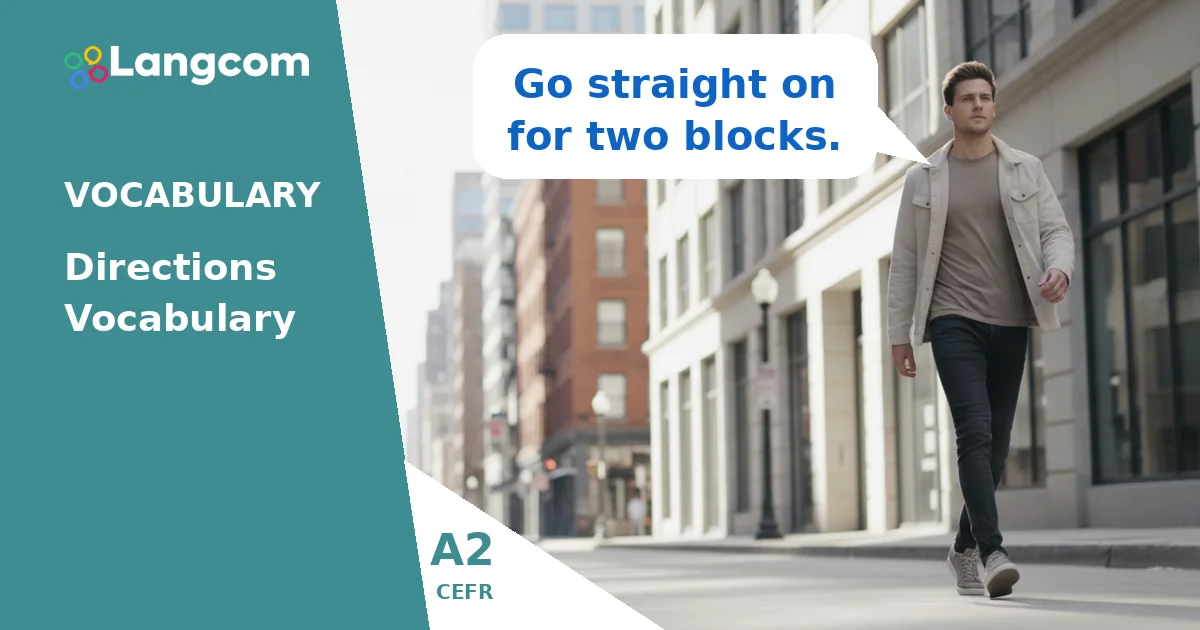
- Go straight on for two blocks.
- Turn left at the roundabout.
- Cross the bridge and you'll see it.
- The shop is on the right, next to the bank.
- Walk past the school.
- The bus stop is opposite the cinema.
- You will see the traffic lights ahead.
Übung
Bist du bereit, dein Zertifikat zu erwerben?
Der Kurs Langcom bereitet die Teilnehmer auf die Prüfungen von Cambridge, IELTS, TOEFL, DELE, SIELE und Michigan vor.
Erste Schritte mit LangcomHäufige Fehler bei Spanischsprechern
Spanish speakers often make a few common mistakes when giving or asking for directions in English.
- Using 'in' instead of 'on' for position: Remember to use on the left oder on the right, nicht in the left. For example: The cafe is on the right. (Correct) not The cafe is in the right. (Incorrect).
- Confusing 'cross' and 'go over': While similar, cross is general for roads, while go over is often used for bridges or hills. Cross the street. (Correct). Go over the bridge. (Correct).
- Missing 'the' before landmarks: Sometimes, learners forget the definite article. Always say at the traffic lights oder at the roundabout.
Häufig gestellte Fragen
What are the most important words for A2 English directions?
For A2 English, focus on verbs like go straight, turn left/right, cross, and nouns like traffic lights, roundabout, bridge, street, road. Also, prepositions like on the left/right, next to, und opposite are very useful.
How can I practice giving directions for the A2 Key exam?
For the A2 Key (KET) exam, you might need to describe a route or location. Practice by looking at a map and describing how to get from one point to another using the vocabulary you've learned. You can also ask a friend to give you directions and try to follow them on the map.
What is the difference between 'street' and 'road'?
Beides street und road refer to a path for vehicles. Street often implies a road in a town or city, usually with buildings on both sides. Road is a more general term and can be anywhere, including outside of cities. For directions, they are often interchangeable, but street is more common in urban contexts.

0 Kommentare