

How Do You Ask for Directions in English?
When you are lost or need help, you can use simple questions to ask for directions.
- Excuse me, how do I get to the train station?
- Can you tell me the way to the museum, please?
- Where is the nearest bus stop?
- Is there a supermarket near here?
✍️ ¿No sabes en qué nivel estás?
Realiza nuestra prueba de nivel gratuita y recibe comentarios personalizados de examinadores certificados por Cambridge.
Realice nuestra prueba de nivel GRATUITAKey Verbs for Giving Directions
These verbs tell people how to move from one place to another.
- Go straight (on): Continue moving forward without turning.
- Turn left / Turn right: Change your direction to the left or right.
- Go past: Move beyond something without stopping.
- Cross: Go from one side of a road or bridge to the other.
- Go over: Move across something, often a bridge or a small hill.
Important Places and Landmarks
You need to know these words to understand where to turn or what to look for.
- Traffic lights: Red, yellow, and green lights that control cars and pedestrians.
- Roundabout: A circular intersection where traffic moves in one direction.
- Bridge: A structure that carries a road or railway over a river or another road.
- Pedestrian crossing (o crossing): A marked place where people can cross the road safely.
- Square: An open public area in a city or town, often surrounded by buildings.
- Corner: The point where two streets meet.
Prepositions for Describing Location
These words help you say exactly where something is.
- On the left / On the right: To indicate position.
- Opposite: Facing something directly.
- Next to: Beside something.
- Between: In the space separating two things.
- At the end of the street: The final part of a street.
Putting It All Together: A Short Dialogue
Here is an example of how to ask for and give directions using the vocabulary you learned.
- Person A: Excuse me, how do I get to the library?
- Person B: Go straight on this street. Turn right at the traffic lights. The library is on your left, opposite the park.
- Person A: Thank you!
| English Word/Phrase | Meaning/Use |
|---|---|
| Turn left / Turn right | To change your direction. |
| Go straight (on) | To continue moving forward without turning. |
| Go past | To move beyond something. |
| Cross | To go from one side of a path to the other. |
| Go over | To move across something, often a bridge or hill. |
| Traffic lights | Lights that control the flow of traffic. |
| Roundabout | A circular intersection for traffic. |
| Bridge | A structure carrying a road over an obstacle. |
| Pedestrian crossing | A marked place for people to cross the road. |
| Square | An open public area in a city or town. |
| On the left / On the right | To indicate position relative to direction. |
Ejemplos
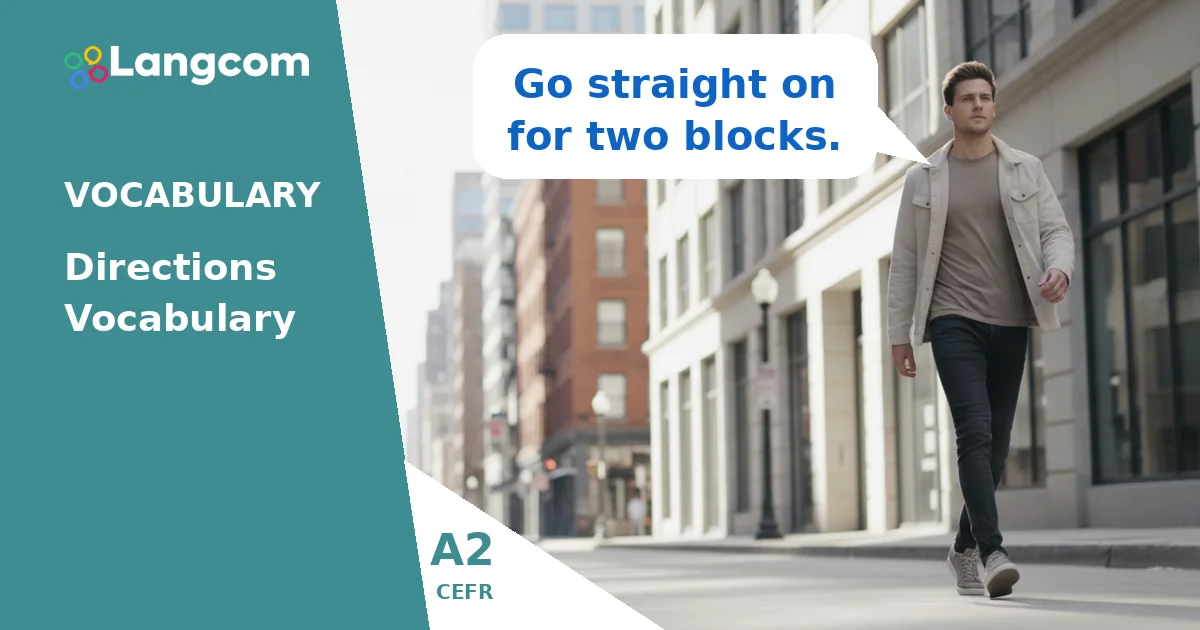
- Go straight on for two blocks.
- Turn left at the roundabout.
- Cross the bridge and you'll see it.
- The shop is on the right, next to the bank.
- Walk past the school.
- The bus stop is opposite the cinema.
- You will see the traffic lights ahead.
Práctica
¿Estás listo para obtener tu certificado?
El curso Langcom prepara a los alumnos para los exámenes de Cambridge, IELTS, TOEFL, DELE, SIELE y Michigan.
Empieza a utilizar LangcomErrores habituales de los hispanohablantes
Spanish speakers often make a few common mistakes when giving or asking for directions in English.
- Using 'in' instead of 'on' for position: Remember to use on the left o on the right, no in the left. For example: The cafe is on the right. (Correct) not The cafe is in the right. (Incorrecto).
- Confusing 'cross' and 'go over': While similar, cross is general for roads, while go over is often used for bridges or hills. Cross the street. (Correct). Go over the bridge. (Correct).
- Missing 'the' before landmarks: Sometimes, learners forget the definite article. Always say at the traffic lights o at the roundabout.
Preguntas más frecuentes
What are the most important words for A2 English directions?
For A2 English, focus on verbs like go straight, turn left/right, cross, and nouns like traffic lights, roundabout, bridge, street, road. Also, prepositions like on the left/right, next to, y opposite are very useful.
How can I practice giving directions for the A2 Key exam?
For the A2 Key (KET) exam, you might need to describe a route or location. Practice by looking at a map and describing how to get from one point to another using the vocabulary you've learned. You can also ask a friend to give you directions and try to follow them on the map.
What is the difference between 'street' and 'road'?
Ambos street y road refer to a path for vehicles. Street often implies a road in a town or city, usually with buildings on both sides. Road is a more general term and can be anywhere, including outside of cities. For directions, they are often interchangeable, but street is more common in urban contexts.

0 Comentarios